
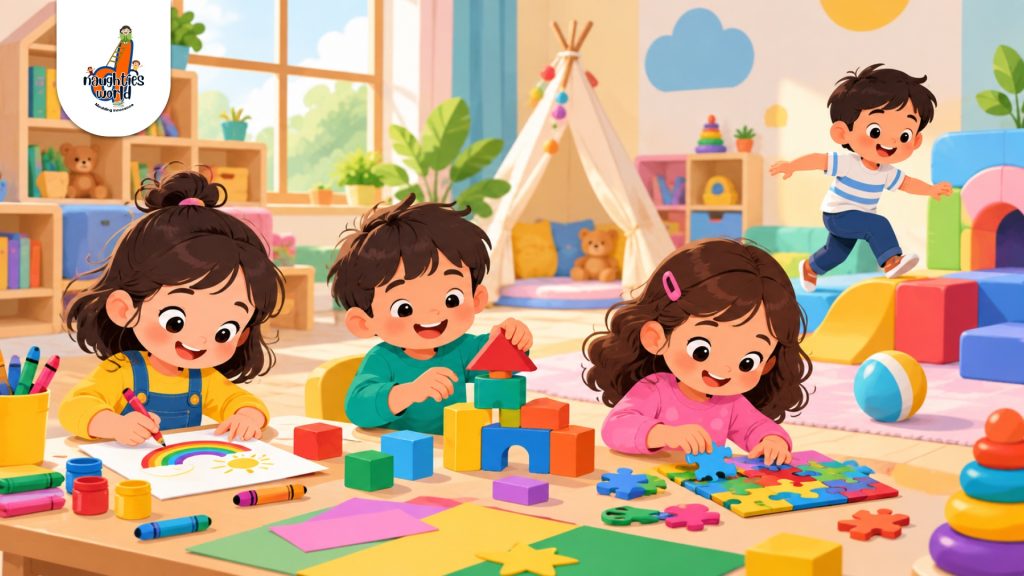
Keeping young children engaged, curious and active is an important part of their early development. However, finding activities that are both entertaining and educational can sometimes be challenging for parents. Whether it is a rainy afternoon, a busy weekday or simply a day spent indoors, the right activities can turn ordinary moments into valuable learning experiences.
Indoor activities for kids offer more than just entertainment. From creative art sessions and imaginative role-playing to puzzles, building blocks and interactive games, these activities give children opportunities to explore their interests, develop new skills and express themselves. With the right environment, even simple games can encourage curiosity, independence and meaningful interaction.
At d Naughties World, play and learning come together to create engaging experiences for young children. By encouraging exploration, creativity and interaction, play-based activities can help children develop essential skills while enjoying their early learning journey.
Why Are Indoor Activities Important for Children’s Development?
Children naturally learn by exploring their surroundings, asking questions and experimenting with different things. Indoor activities provide opportunities for this exploration in a comfortable and structured environment.
For young children, play is closely connected to learning. Activities such as drawing, building, storytelling and solving puzzles can encourage different aspects of development. They also give children opportunities to make decisions, try new ideas and learn through experience.
One of the key advantages of indoor play is its flexibility. Parents and educators can introduce activities according to a child’s age, interests and abilities. A simple activity such as arranging colourful blocks can become an opportunity to explore shapes, colours, patterns and problem-solving.
Play also encourages children to interact with others. Group activities help them practise sharing, communication and cooperation, while independent play allows them to explore their own interests and develop confidence.
The objective is not to make every activity a formal lesson. Instead, children should have opportunities to enjoy themselves while naturally discovering new skills.
10 Engaging Indoor Activities for Kids
The most effective indoor activities are often those that allow children to participate actively rather than simply follow instructions. A combination of creative, physical, sensory and problem-solving activities can keep children interested while supporting different areas of development.
Here are ten activities that parents and educators can introduce into children’s daily routines.
1. Arts and Crafts for Creative Expression
Arts and crafts are among the most engaging indoor activities for kids because they allow children to express their thoughts and imagination through colours, shapes and materials.
Drawing, colouring, painting, paper folding and creating simple crafts give children the freedom to experiment. They can make greeting cards, create colourful patterns, build paper animals or decorate objects using child-safe materials.
These activities also provide opportunities to practise fine motor skills. Holding crayons, using paintbrushes, cutting paper with child-safe scissors and sticking shapes onto paper involve hand movements that children gradually learn to control.
More importantly, creative activities encourage children to make their own choices. Rather than expecting every child to produce the same result, parents and teachers can allow them to explore different ideas and express their individuality.
At d Naughties World, creative activities can form a valuable part of a play-based learning environment where children are encouraged to explore their imagination.
2. Building Blocks and Construction Games
Building blocks are simple yet versatile learning materials that can keep children engaged for extended periods. Children can use them to construct towers, houses, bridges, roads and imaginative structures.
As they build, children begin to understand basic concepts such as size, shape, balance and spatial relationships. They also learn through trial and error. When a tower falls, they can experiment with different arrangements to make it more stable.
Construction games encourage problem-solving and logical thinking. Children may also develop patience as they work towards completing a structure.
Playing together adds another dimension to the activity. Children can share blocks, exchange ideas and collaborate on larger constructions. These interactions introduce teamwork and communication in a natural way.
Parents and educators can make the activity more interesting by suggesting simple challenges, such as building the tallest tower or creating a house for a toy.
3. Storytelling and Interactive Reading
Storytelling is an excellent indoor activity for developing children’s language skills and imagination. Picture books, illustrated stories and simple storytelling games can introduce children to new words, characters and situations.
Instead of simply reading a story from beginning to end, parents and educators can make the experience interactive. Asking questions such as “What do you think happens next?” or “Why is the character happy?” encourages children to think about the story and express their ideas.
Children can also create their own stories using toys, puppets or picture cards. This allows them to develop their imagination while practising communication.
Storytelling can introduce important social and emotional concepts, too. Stories about friendship, sharing, kindness and cooperation provide opportunities to discuss everyday experiences and feelings.
Regular reading and storytelling can make language learning enjoyable without making it feel like a classroom exercise.
4. Indoor Treasure Hunts
A treasure hunt can turn an ordinary room into an exciting space for exploration. This activity involves hiding safe, age-appropriate objects and giving children clues to find them.
For younger children, the clues can be simple, such as identifying colours, shapes or familiar objects. Older children can follow picture clues, solve basic riddles or complete small challenges before finding the next item.
Treasure hunts encourage observation, concentration and problem-solving. Children learn to follow instructions, remember clues and think about where an object might be hidden.
The activity can also introduce basic counting and classification. For example, children might be asked to find three red objects or collect objects of different shapes.
Parents should ensure that the hiding places are safe and suitable for the child’s age. The purpose is to encourage exploration and enjoyment rather than create unnecessary competition.
5. Puzzles and Matching Games
Puzzles and matching games are useful indoor activities for children who enjoy challenges. They introduce children to problem-solving while encouraging them to pay attention to details.
Simple puzzles involving animals, fruits, vehicles or familiar objects can help younger children recognise shapes and patterns. As children become more confident, they can gradually move towards puzzles with more pieces and complex designs.
Matching games are another useful option. Children can match identical pictures, pair objects with their corresponding shapes or group items according to colour and size.
These activities encourage concentration, visual recognition and logical thinking. They also teach children that solving a problem sometimes requires patience and repeated attempts.
Parents and educators can support children by offering guidance when needed without immediately providing the answer. Allowing children to work through a challenge at their own pace can help them develop confidence in their abilities.
6. Music, Dance and Movement Games
Indoor play does not have to involve sitting at a table. Music and movement games provide opportunities for children to stay physically active while having fun.
Simple activities such as dancing to music, musical statues, clapping games and action songs can be enjoyed in a suitable indoor space.
These activities encourage children to listen carefully, follow instructions and coordinate their movements. Songs with repeated words and actions can also support language development and memory.
Group movement games introduce opportunities for social interaction. Children learn to take turns, follow simple rules and participate alongside others.
For younger children, familiar nursery rhymes accompanied by hand movements can be particularly engaging. Older children may enjoy creating their own dance routines or inventing actions to accompany a song.
It is important to provide enough space and remove objects that could cause trips or injuries before starting movement-based activities.
7. Pretend Play and Role-Playing
Children often enjoy pretending to be someone else. Whether they are playing shopkeeper, doctor, teacher, chef or explorer, role-playing allows them to create imaginary situations based on their observations and experiences.
Pretend play is particularly valuable because it gives children opportunities to explore everyday situations in their own way. A simple pretend grocery store, for example, can introduce basic concepts such as counting, exchanging items and communicating with others.
Role-playing also encourages children to use language creatively. They may invent conversations, assign characters to their toys and develop stories as they play.
When children participate in group role-playing, they can practise cooperation, negotiation and taking turns. They may also begin to understand different perspectives by imagining how another person might think or feel.
Parents and educators can provide simple props, such as toy kitchen utensils, dolls, toy food and costumes, while allowing children to lead the activity.
8. Sensory Play and Exploration
Sensory activities allow children to explore different textures, shapes, sounds and materials. They can be particularly engaging for young children who enjoy learning through hands-on experiences.
Activities such as playing with modelling dough, exploring textured objects, sorting coloured materials and experimenting with water can introduce children to different sensory experiences.
For example, children can use modelling dough to create shapes, animals or simple objects. This encourages creativity while giving them opportunities to practise hand movements.
Sorting activities can also be adapted to different age groups. Children might arrange large, safe objects according to colour, texture or size.
Sensory play encourages curiosity and gives children opportunities to investigate how different materials feel and behave. However, activities should always use age-appropriate materials and be supervised, particularly when small objects or water are involved.
9. Simple Science Experiments
Children are naturally curious about how things work. Simple science activities can help them explore everyday concepts through observation and experimentation.
For example, parents can demonstrate how different objects float or sink in a container of water. Children can make predictions, observe what happens and discuss their findings.
Another simple activity involves mixing different colours using child-safe paints or coloured water. Children can observe how two colours combine to create a new one.
These experiences introduce basic scientific thinking. Children learn to ask questions, make predictions, observe results and explore possible explanations.
The objective is not to teach complicated scientific theories. Instead, simple experiments can help children develop curiosity and become more comfortable exploring unfamiliar ideas.
Adults should select safe experiments suitable for the child’s age and supervise the entire activity.
10. Board Games and Group Activities
Board games and simple group activities provide opportunities for children to learn while interacting with others.
Age-appropriate games involving colours, shapes, numbers and picture matching can help children practise recognition and memory. Games that require taking turns also introduce important social skills.
Children gradually learn that games have rules and that everyone gets an opportunity to participate. They may also practise handling small disappointments when they do not win.
For younger children, the emphasis should be on participation and enjoyment rather than competition. Parents and educators can choose cooperative games in which children work together towards a shared goal.
Group activities also create opportunities for conversation, collaboration and friendship.
How Indoor Activities Support Early Childhood Learning
Indoor activities can contribute to several important areas of early childhood development. Their value depends on how they are introduced, the child’s age and interests, and the opportunities available for meaningful participation.
Cognitive development: Puzzles, building blocks, sorting games and simple experiments encourage children to observe, compare, remember and solve problems. These activities introduce basic concepts through practical experiences.
Language development: Storytelling, role-playing, singing and group conversations provide opportunities to learn new words and communicate ideas. Children can practise listening, expressing themselves and responding to others.
Physical development: Drawing, painting, modelling dough and construction activities involve fine motor movements. Dancing and movement games encourage coordination and physical activity.
Social and emotional development: Group games, pretend play and collaborative activities allow children to practise sharing, cooperation and communication. They also provide opportunities to express emotions and develop relationships.
Creativity and imagination: Art, storytelling, construction and pretend play encourage children to explore their own ideas. Children can experiment with different ways of creating, building and expressing themselves.
These benefits are not limited to organised educational activities. Everyday play can also provide meaningful learning opportunities when children have the freedom to explore and adults offer appropriate support.
Choosing the Right Indoor Activities According to Age
Not every activity is suitable for every child. An activity that interests a preschooler may be too challenging for a toddler, while an older child may need more complex tasks to remain engaged.
For toddlers, simple activities involving colours, shapes, music, picture books and large building blocks can encourage exploration. Activities should be short, flexible and closely supervised.
Preschoolers may enjoy more interactive experiences, such as pretend play, simple puzzles, drawing, storytelling and basic sorting games. At this stage, children can also begin participating in activities that involve following simple instructions.
Older children may enjoy more challenging puzzles, construction projects, creative storytelling, board games and simple science experiments. These activities can provide opportunities to practise independent thinking and problem-solving.
Regardless of age, it is important to consider each child’s interests and abilities. Some children enjoy group activities, while others prefer independent exploration. Offering different options allows children to discover what they enjoy.
Creating a Safe and Engaging Indoor Play Environment
A good indoor play environment does not need expensive equipment or elaborate decorations. What matters most is providing children with suitable materials, enough space and opportunities to explore.
Parents and educators can create different activity areas for reading, drawing, construction and imaginative play. Keeping materials organised and accessible can help children make independent choices.
Safety should remain a priority. Toys and materials should be appropriate for the child’s age, and small objects that may pose choking hazards should be kept away from younger children. Movement activities require sufficient space, while water-based and sensory activities need appropriate supervision.
It is also useful to maintain a balance between structured activities and free play. Structured activities introduce children to specific tasks, while free play gives them the freedom to make their own decisions and follow their interests.
Children do not need to be occupied every minute. Allowing them some unstructured time can encourage independent thinking and creativity.
The Role of Play-Based Learning at d Naughties World
Early childhood is an important period for developing curiosity, communication, creativity and social skills. A supportive learning environment can help children explore these abilities through meaningful experiences.
At d Naughties World, play-based learning provides a way to make early learning more engaging and enjoyable. Indoor activities can introduce children to different experiences while allowing them to learn through exploration and interaction.
Creative activities, storytelling, games and hands-on experiences can encourage children to participate actively in their learning journey. They also provide opportunities to develop confidence, express ideas and interact with other children.
For parents, choosing an environment that recognises the importance of play can be an important part of supporting their child’s early learning. The right activities should be enjoyable, age-appropriate and flexible enough to accommodate different interests and abilities.
Rather than focusing only on completing tasks, play-based learning places value on the process of exploring, experimenting and discovering.
How Parents Can Make Indoor Play More Meaningful
Parents play an important role in helping children get the most out of indoor activities. Even a few minutes of shared play can create opportunities for conversation, exploration and connection.
One way to make activities more meaningful is to let children take the lead. Instead of directing every step, parents can allow children to choose their materials, develop their own ideas and experiment with different approaches.
Asking open-ended questions can also encourage curiosity. Questions such as “What would happen if we tried this?” or “Can you think of another way to build it?” invite children to explore possibilities.
It is equally important to recognise effort rather than focusing entirely on the final result. A child’s drawing does not have to look perfect, and a block tower does not have to be the tallest. Encouraging experimentation helps children become more comfortable trying new things.
Parents can also rotate activities to maintain children’s interest. Introducing a different puzzle, craft project or storytelling game from time to time can make familiar play environments feel fresh.
Most importantly, indoor activities should remain enjoyable. Children benefit from having the freedom to explore without feeling that every moment of play needs to produce a specific result.
Conclusion
Indoor play offers children opportunities to explore, create, communicate and develop new skills in a comfortable environment. From arts and crafts to puzzles, storytelling, music and imaginative games, a variety of activities can make everyday play both enjoyable and meaningful.
For parents, the key is to choose activities that match their child’s age, interests and abilities while allowing enough freedom for independent exploration. A balanced combination of guided activities and free play can help children discover their interests and build confidence.
At d Naughties World, the emphasis on play-based learning reflects the importance of making early childhood experiences engaging and enjoyable. With the right activities and a supportive environment, indoor play can become a valuable part of a child’s learning journey.
Frequently Asked Questions
1. What are some fun indoor activities for kids?
Some engaging indoor activities include arts and crafts, building blocks, storytelling, puzzles, treasure hunts, music and dance, pretend play and simple science experiments. These activities provide opportunities for children to explore their interests while developing different skills.
2. How do indoor activities help children’s development?
Indoor activities can support cognitive, language, physical, social and emotional development. For example, puzzles encourage problem-solving, storytelling supports language development, and group games provide opportunities to practise communication and cooperation.
3. What are the best indoor activities for preschoolers?
Preschoolers often enjoy drawing, painting, building blocks, pretend play, interactive storytelling, matching games and simple puzzles. Activities that combine creativity, exploration and interaction can help maintain their interest while supporting early learning.
4. How can parents keep children engaged indoors?
Parents can offer a variety of age-appropriate activities, including creative projects, games, reading and hands-on exploration. Allowing children to choose activities, experiment independently and participate in shared play can also help maintain their interest.
5. Are indoor activities suitable for early childhood learning?
Yes. Indoor activities can provide valuable learning opportunities when they are age-appropriate and engaging. Play-based experiences allow young children to explore concepts, practise skills and learn through observation and experimentation.
6. How does d Naughties World encourage learning through play?
d Naughties World focuses on making early learning engaging through play-based experiences. Activities involving creativity, exploration and interaction can help children develop essential skills while enjoying their learning journey.