
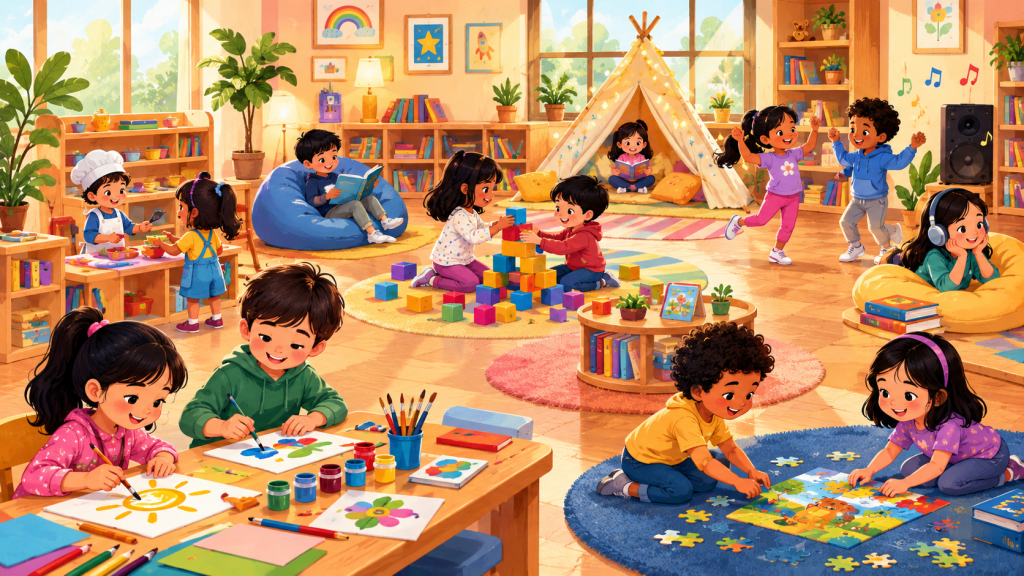
Keeping children entertained can be a challenge, especially when outdoor play is not always possible. Rainy days, extreme weather, school holidays, and busy family schedules often leave parents looking for ways to keep their little ones occupied without relying entirely on television, mobile phones, or video games.
Fortunately, there are plenty of indoor activities for kids that combine fun with opportunities to learn, explore, and develop new skills. From creative art projects and imaginative role-play to interactive games and physical challenges, indoor play can offer much more than a way to pass the time.
The key is to choose activities that match a child’s age, interests, and energy levels. Whether children enjoy building things, solving puzzles, moving around, or expressing themselves creatively, the right indoor environment can turn an ordinary day into an exciting experience.
At dNaughties World, the idea of children’s play centres around making fun an opportunity for exploration, creativity, and meaningful engagement. With the right activities and a little imagination, indoor play can become an enjoyable part of a child’s everyday routine.
Why Indoor Activities Are Important for Children
Play is an essential part of childhood. It gives children opportunities to explore their surroundings, interact with others, practise new skills, and understand the world around them. While outdoor play offers its own benefits, indoor activities can provide equally valuable opportunities when they are planned thoughtfully.
One of the biggest advantages of indoor play is its versatility. Children can participate in creative projects, interactive games, movement-based activities, and problem-solving challenges without depending on the weather or outdoor conditions.
Indoor activities can also support different aspects of a child’s development. Drawing and craft projects encourage creativity and fine motor coordination, while puzzles and building games introduce problem-solving and logical thinking. Group games can help children practise sharing, cooperation, communication, and patience.
Just as importantly, structured and unstructured play both have a place in a child’s routine. Organised activities can introduce new challenges, while free play allows children to make their own choices, follow their curiosity, and develop independence.
10 Fun Indoor Activities for Kids to Enjoy
Finding the right activity does not always require expensive equipment or elaborate planning. Often, a simple idea can keep children interested when it gives them room to participate, experiment, and have fun.
1. Arts and Crafts for Creative Expression
Arts and crafts are among the most versatile indoor activities for kids because they allow children to turn their ideas into something tangible. Drawing, painting, paper folding, collage-making, and creating simple decorations can all become enjoyable ways to spend time indoors.
Younger children may enjoy experimenting with colours, shapes, and textures, while older children can try more detailed projects such as greeting cards, handmade bookmarks, or themed artwork.
These activities can encourage imagination, concentration, and fine motor skills. Parents do not need to focus on producing a perfect result. Giving children the freedom to choose colours, materials, and designs often makes the experience more enjoyable.
For a simple activity, provide paper, washable colours, child-safe scissors, and glue, then let children create something based on a favourite animal, story, or imaginary world.
2. Building and Construction Games
Building activities can turn ordinary playtime into an opportunity for experimentation. Children can use building blocks, magnetic tiles, age-appropriate construction sets, or cardboard boxes to create towers, bridges, houses, and imaginary cities.
As children build, they begin exploring concepts such as balance, size, shape, and spatial relationships. They may also learn to adapt their ideas when a structure falls or does not work as expected.
Parents can make the activity more engaging by introducing a simple challenge: build the tallest tower, create a house for a toy, or design a bridge that can hold a small object. The aim is not to get every structure right the first time. It is to encourage children to think creatively, experiment with different approaches, and enjoy the process of discovery.
3. Indoor Treasure Hunts
A treasure hunt is a great way to add excitement and movement to an ordinary day at home. Parents can hide safe objects around a room and provide clues that help children locate them. For younger children, clues can involve colours, shapes, or simple descriptions. Older children may enjoy solving riddles or completing small tasks before moving to the next clue.
A treasure hunt can also follow a theme, such as animals, favourite storybook characters, or a pretend adventure. This encourages children to use their imagination while practising observation and problem-solving. Make sure the hiding places are safe and appropriate for the child’s age. The activity should encourage exploration without requiring children to climb furniture or access potentially dangerous areas.
4. Puzzles and Brain Games
Puzzles provide a quieter alternative to high-energy play while keeping children’s minds engaged. Jigsaw puzzles, matching games, memory cards, mazes, and age-appropriate logic challenges can all help children practise concentration and reasoning.
Younger children may start with simple shape sorters and picture-matching games. As they grow, they can explore more complex puzzles, word games, and challenges that require them to recognise patterns or plan several steps ahead.
Parents can participate by solving a puzzle together rather than immediately providing answers. Asking questions such as “What could fit here?” or “What happens if we try this piece?” encourages children to think through a problem independently.
These activities can also teach patience. Completing a challenge may take time, and learning to keep trying when something feels difficult is a valuable part of the experience.
5. Pretend Play and Imaginative Role-Play
Children often enjoy pretending to be someone else. They may imagine themselves as doctors, chefs, shopkeepers, teachers, explorers, or characters in a story.
Role-play gives children a chance to create their own situations, develop dialogue, and experiment with different roles. A pretend shop, for example, can introduce simple counting and communication, while a pretend restaurant can encourage children to organise a menu, assign roles, and interact with others.
Parents can provide everyday objects or toys that support the story, but children should have plenty of freedom to decide how the game unfolds. Imaginative play is particularly valuable because there is no single correct outcome. Children can invent new characters, change the rules, and build entire stories around their interests.
6. Music, Dance and Movement Games
Children need opportunities to move, even when they are spending the day indoors. Music and movement games can help break up long periods of sitting while making physical activity enjoyable. Try a game of musical statues, a simple dance challenge, an indoor movement sequence, or an action game in which children follow instructions such as jumping, clapping, stretching, or balancing.
Movement activities can support coordination, body awareness, and rhythm. They can also provide an enjoyable way for children to release energy and change the pace of their day. Choose a clear, open space and remove objects that could cause trips or falls. Activities should be adapted to the child’s age and physical abilities, with adult supervision where appropriate.
7. Storytelling and Puppet Shows
Stories can take children into new worlds without leaving the room. Parents can read a favourite book aloud, encourage children to invent their own stories, or use puppets and soft toys to create a short performance.
A simple storytelling game begins with one person introducing a character or setting. The next person adds an event, and everyone takes turns building the story. This can help children practise listening, language, sequencing, and self-expression. It also creates opportunities for family members to share an activity without needing screens or complicated materials. For children who enjoy performing, making simple paper puppets and putting on a small show can combine storytelling with arts and crafts.
8. Simple Science Experiments
Children are naturally curious about how things work. Age-appropriate science activities can turn that curiosity into an enjoyable indoor learning experience. For example, children can explore which everyday objects float or sink in water, observe how shadows change, sort materials by texture, or mix colours using washable paints.
Before beginning, ask children what they think will happen. After the activity, discuss what they observed and whether the result matched their prediction. These small experiments introduce observation, comparison, and early scientific thinking without making the experience feel like a classroom lesson. Adults should prepare the materials, supervise closely, and avoid hazardous substances, heat, sharp objects, or small items that could present choking risks.
9. Board Games and Cooperative Challenges
Board games and group activities offer a way for children to enjoy time with siblings, parents, and friends. Depending on the game, children may practise turn-taking, communication, strategic thinking, and following rules.
Not every game needs to involve winning or losing. Cooperative challenges can encourage children to work towards a shared goal, such as completing a puzzle together or building something as a team. When children are still learning how to handle disappointment, adults can model patience and show that the experience matters more than the outcome. Choosing games that suit the children’s ages and attention spans helps everyone participate comfortably.
10. Interactive Indoor Play Experiences
Sometimes, children benefit from a change of environment rather than another activity at home. Interactive indoor play experiences can give them access to different challenges, play equipment, and opportunities to interact with other children.
Depending on the venue, these experiences may include movement-based play, imaginative settings, creative activities, or age-appropriate interactive challenges. A dedicated indoor play destination can be particularly useful during school holidays, weekends, family outings, or days when outdoor activities are less practical. Parents should review the venue’s facilities, age recommendations, supervision arrangements, and safety guidelines before visiting.
For families exploring engaging play options, dNaughties World can be considered as part of the search for enjoyable experiences that give children a chance to play, explore, and make memorable moments.
How to Choose the Right Indoor Activities for Kids
Not every activity suits every child. Some children enjoy energetic games, while others prefer drawing, puzzles, or imaginative play. The most suitable activity depends on several factors.
Consider your child’s age. Younger children generally benefit from simple activities with clear actions and safe, easy-to-handle materials. Older children may prefer challenges that involve planning, creativity, teamwork, or more complex problem-solving.
Follow their interests. A child who loves animals may enjoy creating an animal-themed story or building a pretend zoo. A child interested in construction may prefer blocks and design challenges. Starting with existing interests can make it easier to introduce something new.
Balance active and quiet play. A day filled entirely with high-energy activities can be tiring, while too much sitting may leave energetic children restless. Alternating movement games with drawing, stories, or puzzles can help create a more balanced routine.
Encourage independence. Give children opportunities to choose an activity, make decisions, and solve small problems. Adult involvement is helpful, but children also need room to experiment and direct their own play.
Keep safety in mind. Use age-appropriate materials, maintain a safe play area, and supervise activities according to the child’s age and needs. For organised venues, check the facility’s safety policies and any age or height restrictions.
The objective is not to keep children occupied every minute. It is to create opportunities for enjoyable play, discovery, social interaction, and rest.
Indoor Activities That Help Children Develop Important Skills
Indoor play can be entertaining while also supporting children’s everyday development. The benefits often depend on how children engage with an activity rather than the activity’s complexity or cost.
Creative activities such as painting, crafts, and storytelling allow children to express ideas and explore their imagination. Construction games and puzzles encourage them to think through problems, recognise patterns, and try different solutions.
Group activities can help children practise cooperation and communication. When children build something together or take turns in a game, they have opportunities to listen, share ideas, and work through small disagreements.
Movement-based activities offer opportunities to practise coordination, balance, and body awareness. Meanwhile, pretend play allows children to explore familiar situations and create new ones through their own stories.
Parents can support these experiences by asking open-ended questions, showing interest in children’s ideas, and allowing them to make mistakes without feeling that every activity must produce a perfect result.
How to Keep Kids Engaged Indoors Without Relying on Screens
Digital entertainment can be convenient, but children also benefit from a variety of hands-on experiences. The aim does not have to be eliminating screens completely. Instead, families can create a routine that includes opportunities for physical movement, creativity, social interaction, and independent play.
One approach is to prepare a small collection of activity options before the day begins. Keep puzzles, drawing materials, building toys, and simple games accessible so children can choose what interests them.
Parents can also introduce themed activity periods. A creative morning might involve drawing and crafts, while the afternoon could include a treasure hunt or a building challenge. On another day, children might enjoy storytelling, music, or a family board game.
It is also important to leave room for unstructured play. Children do not always need an adult to plan every activity. Having time to explore toys, invent games, and follow their own ideas can be valuable in its own right.
For family outings, an indoor play venue can provide a different kind of experience, particularly when children want more variety than the activities available at home.
Why Indoor Play Can Be a Good Option During Weekends and School Holidays
Weekends and school holidays provide children with more time to explore their interests outside the usual school routine. However, parents may not always have the time, space, or materials needed to plan new activities every day.
Indoor activities can offer a convenient way to make this time enjoyable. At home, families can try crafts, games, reading, and simple experiments. When they want a change of setting, they can explore organised indoor activities suitable for their children’s ages and interests.
An indoor outing can also give families an opportunity to spend time together without needing to plan around outdoor conditions. The best choice will depend on the child’s preferences, the facilities available, and the experience the family wants to enjoy.
When choosing a play destination, look beyond the number of activities advertised. Consider whether the environment suits your child, whether the facilities are well maintained, and whether the experience encourages safe, engaging play.
Make Playtime More Meaningful with dNaughties World
Children learn about the world by interacting with it. They explore through movement, imagination, experimentation, and play with other people. Providing opportunities for these experiences can help make everyday leisure time more engaging and enjoyable.
dNaughties World is a name families can explore when looking for children’s play experiences. Whether planning a family outing or searching for new ways to make children’s free time more interesting, parents can focus on activities that encourage curiosity, participation, and enjoyment.
When considering a visit, families should check the latest information about available activities, age suitability, operating hours, and any booking requirements to find an experience that fits their plans.
The best play experiences are not necessarily the most complicated ones. They are the ones that give children room to be curious, try new things, interact with others, and enjoy being themselves.
Conclusion
Finding engaging indoor activities for kids does not have to be difficult. From arts and crafts, building games, and treasure hunts to music, storytelling, puzzles, and interactive play experiences, there are many ways to make time indoors more enjoyable.
The right activities can provide opportunities for creativity, problem-solving, movement, communication, and social interaction while giving children a welcome break from their usual routines. By considering a child’s age, interests, and energy levels, parents can create a balanced mix of active, creative, and independent play.
Whether enjoying a simple activity at home or exploring a dedicated indoor play destination, the goal is to make playtime fun, safe, and meaningful. For families looking to add variety to their children’s leisure time, dNaughties World is worth exploring as part of the search for engaging indoor play experiences.