
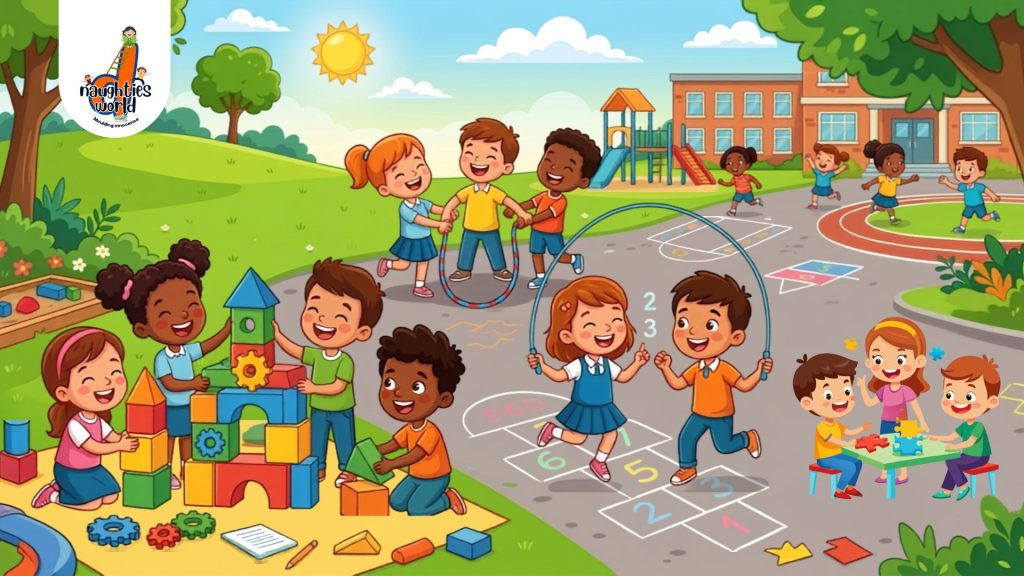
Preschool is a special time when children are curious about everything around them. They want to touch, explore, ask questions, move around, and, most importantly, play. For young children, play is not just entertainment. It is one of the best ways to learn.
The right school games for kids can help preschoolers develop important skills such as communication, problem-solving, teamwork, creativity, memory, and coordination. The best part? Children can learn these skills without feeling like they are studying.
At dNaughties World, we believe learning should feel exciting, playful, and age-appropriate. Here are 10 fun games that preschool teachers and parents can introduce to make learning more enjoyable.
1. Treasure Hunt
Children naturally love searching for hidden objects. A simple treasure hunt game for kids can turn an ordinary classroom or play area into an exciting learning adventure.
Hide safe objects around the room and give children simple clues. You can make the game educational by asking them to find something of a particular colour, shape, letter, or number.
This activity helps children improve their observation skills, memory, listening, and problem-solving abilities while keeping them active.
2. Simon Says
“Simon Says” is a classic game that preschoolers can enjoy almost anywhere. One person becomes Simon and gives instructions such as “Simon says touch your nose” or “Simon says jump three times.”
Children must listen carefully and follow the instruction only when it begins with “Simon says.”
This simple game supports listening skills, concentration, body awareness, and following instructions. It is also a great way to help energetic preschoolers move around while learning.
3. Colour Sorting Game
Learning colours becomes much more exciting when children can play with real objects.
Give children different coloured blocks, balls, toys, or classroom objects. Ask them to sort the items into groups according to their colours. As they become more confident, introduce shapes, sizes, or patterns.
Colour sorting encourages early mathematical thinking, classification, observation, and decision-making skills.
4. Story Building Game
Preschoolers have wonderful imaginations, so why not turn storytelling into a group game?
Start with a simple sentence such as, “One day, a little white rabbit went into the forest…” Then allow each child to add one sentence to continue the story.
There is no right or wrong answer. The story can become funny, surprising, or completely imaginative.
This game encourages creativity, vocabulary, communication, confidence, and imagination. It also teaches children to listen to what others are saying.
5. Musical Statues
Put on some cheerful music and let the children dance. When the music stops, everyone has to freeze like a statue.
You can make the game more interesting by asking children to freeze like animals, superheroes, trees, or their favourite characters.
Musical statues help develop balance, coordination, listening skills, body control, and confidence. It is also a wonderful way to release energy in a positive way.
6. Memory Match
Memory games are a great way to make learning feel like play. Place picture cards face down and let children take turns turning over two cards at a time. If they find a matching pair, they keep the cards.
You can use pictures of animals, fruits, colours, shapes, or everyday objects depending on the children’s age.
The game supports memory, concentration, visual recognition, and patience while also teaching children how to take turns.
7. Build It Together
Give children building blocks, LEGO-style bricks, or other age-appropriate construction toys and give them a simple challenge.
For example, ask them to build a house, bridge, tower, or playground together.
The focus should not be on making the ‘perfect’ structure. Instead, encourage children to discuss ideas, share materials, and solve problems as a team.
This activity builds teamwork, creativity, fine motor skills, communication, and early engineering thinking.
8. Shape Hunt
Learning shapes becomes more meaningful when children can find them in the world around them.
Ask children to look around their classroom or play area and find objects that are circles, squares, rectangles, or triangles. A clock may be a circle, a window may be a rectangle, and a toy block may have several different shapes.
Shape hunts improve visual awareness, early geometry skills, observation, and vocabulary.
9. Animal Charades
Children can choose or receive the name of an animal and act it out without speaking. Other children then try to guess the animal.
A child might hop like a rabbit, crawl like a turtle, or flap their arms like a bird.
This fun activity encourages creative expression, communication, confidence, imagination, and physical coordination. It can also introduce children to different animals and their movements.
10. Team Relay Games
Simple relay games are perfect for encouraging preschoolers to work together. Divide children into small groups and create an easy challenge, such as carrying a soft ball from one point to another or completing a simple obstacle course.
The goal should be teamwork rather than winning.
Relay games help children understand sharing, cooperation, turn-taking, patience, coordination, and team spirit. They also provide plenty of opportunities for physical activity.
Why Learning Through Play Matters
For preschoolers, sitting still for long periods can be difficult. School games for kids allow them to learn while moving, talking, experimenting, and interacting with others.
When children enjoy an activity, they are more likely to participate, try again after making mistakes, and remember what they have learned. Play-based learning can therefore make early education more engaging and meaningful.
For parents, it is also a reminder that you do not need complicated activities or expensive materials to support your child’s development. Sometimes, a simple game, a few blocks, some music, or a creative story is enough to create a valuable learning experience.
How We Make Learning Fun at dNaughties World
Choosing the right preschool environment can make a big difference in your child’s early learning journey. A good preschool should give children opportunities to learn, play, explore, create, communicate, and build confidence in a safe and nurturing environment.
At dNaughties World, we bring learning and fun together through activities designed around the needs of young children. From creative play to social interaction and skill-building activities, our approach helps children enjoy their early years while developing important skills for the future.
If you are looking for a preschool for your child, explore dNaughties World and discover a learning environment where little minds can play, grow, and thrive.
Happy Minds, Happy Hearts, Happy Learning!