
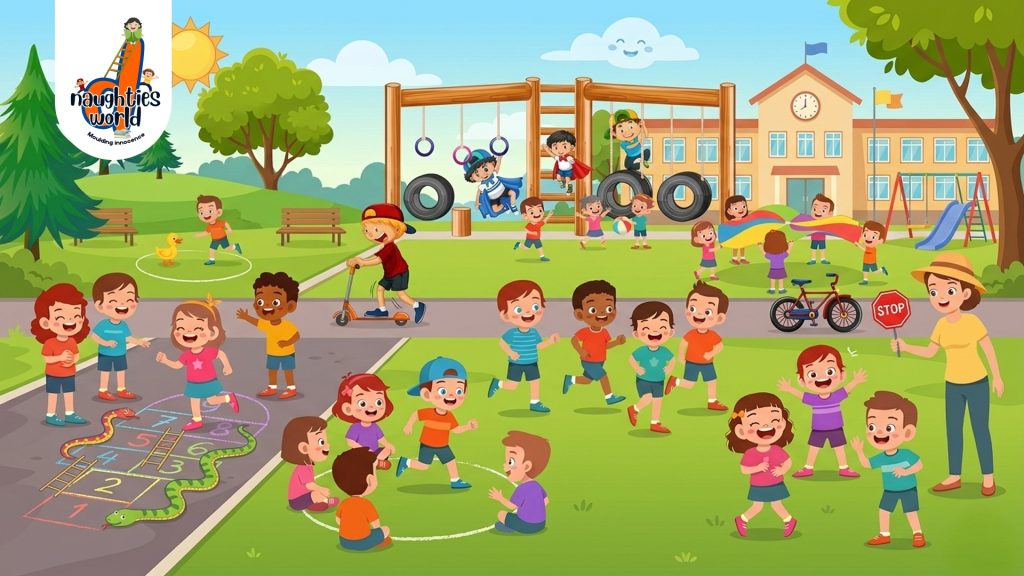
Recess and physical education are more than just breaks from textbooks and whiteboards, they are essential chapters in a child’s school day. In a world increasingly dominated by screens, getting kids outside to move, laugh, and interact is crucial for their physical health and social development.
At dNaughties World, we believe that outdoor play should be inclusive, high-energy, and, above all, simple to set up. You don’t need expensive equipment or hours of preparation to create unforgettable schoolyard memories. Here is a curated list of the best outdoor games for kids at school that are easy to organize and guaranteed to keep everyone engaged.
The Classic Outdoor Games for Kids at School
Octopus Tag
Traditional tag is great, but it can sometimes leave eliminated players sitting on the sidelines. Octopus Tag solves this problem by keeping everyone involved until the very end.
- How to Play: Designate boundaries for a large playing field. One child starts in the middle as the ‘Octopus,’ while the rest of the kids line up at one end. When the Octopus yells ‘Release!’, everyone tries to run to the opposite safe zone. If the Octopus tags a runner, that runner freezes in place and becomes a ‘tentacle.’ In the next round, these frozen players can swing their arms to help tag passing runners without moving their feet.
- Why It Works: It fosters a sense of community. As the game progresses, the chaos builds, and the ‘sea’ gets trickier to navigate, resulting in endless giggles.
Spud
This classic game is excellent for developing hand-eye coordination, quick reflexes, and listening skills. All you need is a soft playground ball.
- How to Play: Gather the children in a circle and assign each a number. One player stands in the center, throws the ball high into the air, and shouts a number. The child with that number must run to catch the ball while everyone else scatters. As soon as the designated player catches the ball, they yell, ‘SPUD!’ Everyone must instantly freeze. The ball-handler can then take up to three large steps toward any player and attempt to gently hit them below the waist with the ball. If they succeed, that player gets an ‘S.’ The first to spell S-P-U-D loses, but the focus remains entirely on the fun of dodging.
- Why It Works: It balances high-intensity running with moments of sudden, dramatic stillness.
Team-Building and Strategy
Capture the Flag (Simplified)
While the traditional version can take hours and require vast woods, a simplified schoolyard version is one of the most fun games for kids at school and it works beautifully on a standard sports field or grassy area.
- How to Play: Divide the playground into two halves and split the kids into two teams. Each team places a bright cone or marker (the ‘flag’) at the back of their territory. The goal is to run into the opponent’s territory, grab their flag, and bring it back safely without being tagged. If a player is tagged on the opponent’s side, they must go to a designated ‘jail’ area until a teammate runs over and tags them out of jail.
- Why It Works: It teaches strategic thinking and cooperation. Kids naturally divide themselves into roles, with some choosing to defend their flag while others plan stealthy rescue missions.
Dragon’s Tail
This is a fast-paced, high-energy game that requires zero setup but demands absolute teamwork.
- How to Play: Divide the children into groups of four to six. Each group forms a line, holding onto the waist or shoulders of the person in front of them to create a ‘dragon.’ The last person in line tucks a bandana or scarf into their back pocket, this is the dragon’s tail. The person at the front of the line is the dragon’s head. The goal is for the ‘head’ of one dragon to steal the ‘tail’ of another dragon, all while keeping their own line intact.
- Why It Works: It requires synchronized movement. If the line breaks, the dragon is temporarily vulnerable, encouraging kids to communicate and move as a single unit.
Low-Equipment, High-Engagement
Red Light, Green Light (With a Twist)
Perfect for younger students, this game helps develop listening skills and impulse control.
- How to Play: One player is the ‘caller’ and stands at the finish line with their back turned. The rest of the students start at the starting line. When the caller shouts ‘Green Light!’, players move forward. When they shout ‘Red Light!’, the caller spins around, and everyone must freeze. To make it more engaging for modern schoolyards, introduce ‘Yellow Light’ (walk in slow motion) or ‘Purple Light’ (hop on one foot). Anyone caught moving on a red light must return to the start.
- Why It Works: It is incredibly easy to manage for large groups and introduces a fun element of suspense.
Bringing it All Together
Outdoor games at school do heavy lifting when it comes to childhood development. They teach children how to negotiate rules, handle winning and losing with grace, and share space with their peers.
When introducing these games, remember to keep the focus on participation rather than strict competition. Rotate roles frequently so every child gets a chance to be the ‘Octopus,’ the ‘Caller,’ or the ‘Dragon’s Head.’ With these easy and engaging ideas, recess will easily become the most anticipated part of the school day.
Happy Minds, Happy Hearts, Happy Learning!